Origami flowers are where beginners discover that easy and impressive are not opposites. None of the twelve below needs more than a dozen or so folds, most forgive a crooked crease, and a handful of them in a jar will outlast any bouquet from a shop. Grab a stack of 15 cm kami — leaf-green included — and work down the list.
 Save
SaveTulip
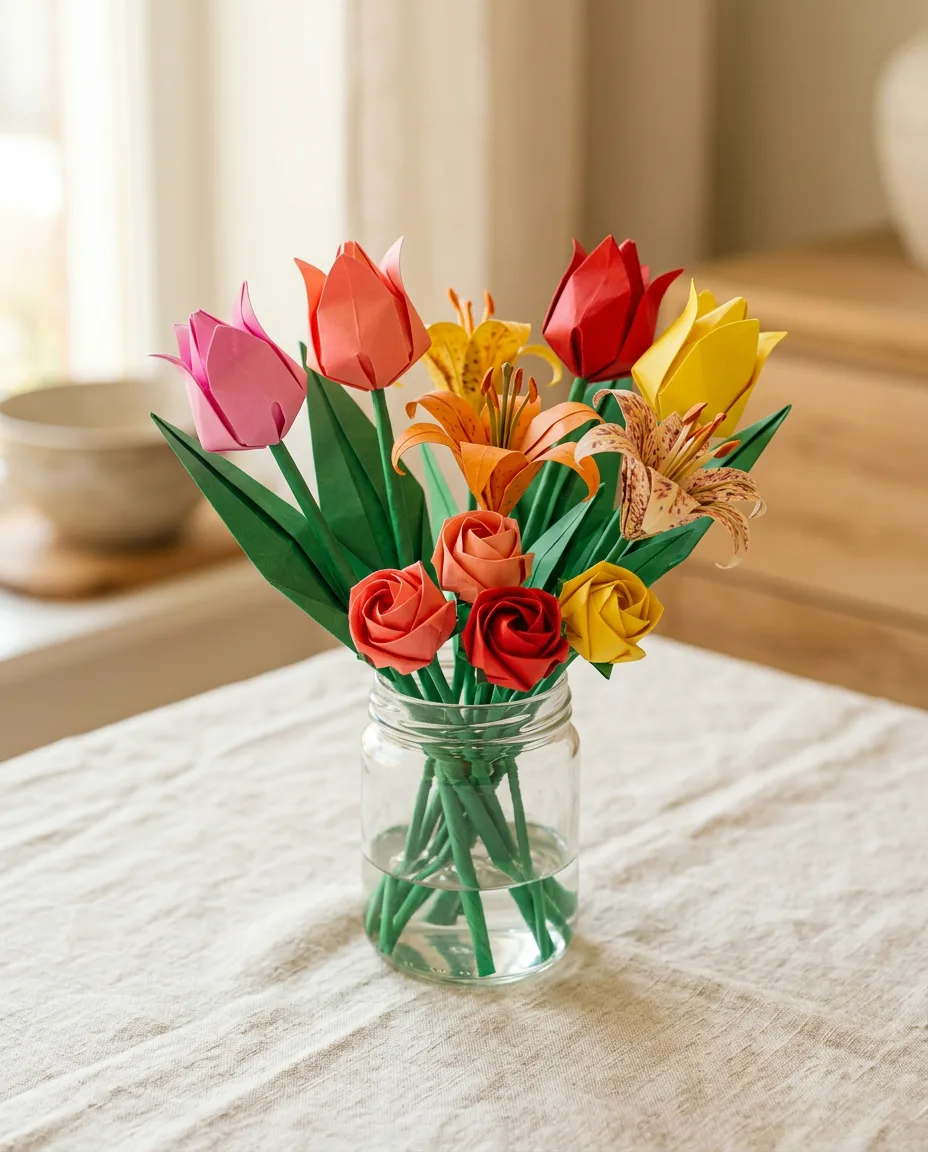
The gateway flower: a four-fold head and a rolled-stem leaf, standing up on its own if you open the base slightly. Fold the head in red or yellow, the stem from a green square, and slide one into the other. A row of five on a windowsill reads as spring from across the room.
Rosebud
The full origami rose is famously hard; the rosebud is its five-minute cousin. A pinwheel-style twist gathers four corners into a closed bud that reads unmistakably as a rose, especially folded from duo paper with a deep red face.
Lily
The classic, and the hardest on this list — it uses the same preliminary and petal folds as the crane, so treat it as a promotion rather than a starting point. Four curling petals from one square; curl them around a pencil at the end. One lily carries a whole vase.
Morning glory
A traditional fold of maybe six creases: blintz the corners, turn, and open the trumpet. From chiyogami it looks like a textile print come loose. These are the flowers to fold twenty of while watching something.
Camellia
Another old Japanese design — a flat, squarish bloom with an offset spiral at the center that looks far cleverer than its folds. Red with a square of yellow glued at the heart is the traditional look.
Lotus
The one your grandmother may already know. Blintz the square three times, then peel each layer of petals back and the flower blooms in your hands — the most satisfying thirty seconds in beginner origami. Fold it from a napkin at dinner and watch it travel around the table.
Four-petal kusudama flower
One petal unit, folded four or five times and glued at the seams into a bloom — the same flower that builds the great kusudama balls, enjoyed singly. Yes, there is a dab of glue; the tradition allows it and so do we.
Daisy pinwheel
A pinwheel base opened flat into eight white points around a yellow center. It lies perfectly flat, which makes it the best of the twelve for greeting cards and scrapbook pages.
Carnation
Less a fold than a pleating trick: accordion-fold, cinch the middle, and fluff. From tissue paper it is a pompom; from kami it is a crisp fan-flower. Kids produce convincing ones on the first try, which is rare and precious.
Cherry blossom
A five-petal blossom needs a pentagon, and cutting a true pentagon from a square is its own small origami lesson (fold, fold, one scissor cut — worth learning). The blossom itself is then four easy folds. Pale pink paper is non-negotiable.
Leaf and stem
Not technically a flower, and the most useful fold on this page. A green square pleated down the diagonal makes a veined leaf; a tight roll makes a stem. Every flower above graduates from cute to convincing the moment it gets one.
A jar of them
The final idea is the arrangement itself: five or seven mixed flowers, stems cut to different heights, in a small glass jar. Unlike the real thing it survives shipping — flatten the heads, tuck them into an origami envelope, and send someone a garden.