Short answer
Fold many copies of one small unit — start with the Sonobe — and lock them tab-into-pocket. Six units make a cube, thirty make the classic kusudama-style ball, and no glue is involved.
Modular origami refuses the hobby’s one sacred rule — one sheet, no glue — and keeps only half of it. Many sheets, still no glue. You fold the same small unit six, twelve, thirty times, then the units grip each other into a cube, a star, or a kusudama ball that looks impossible until you know the secret: every unit is both a pocket and a pair of tabs.
How units hold without glue
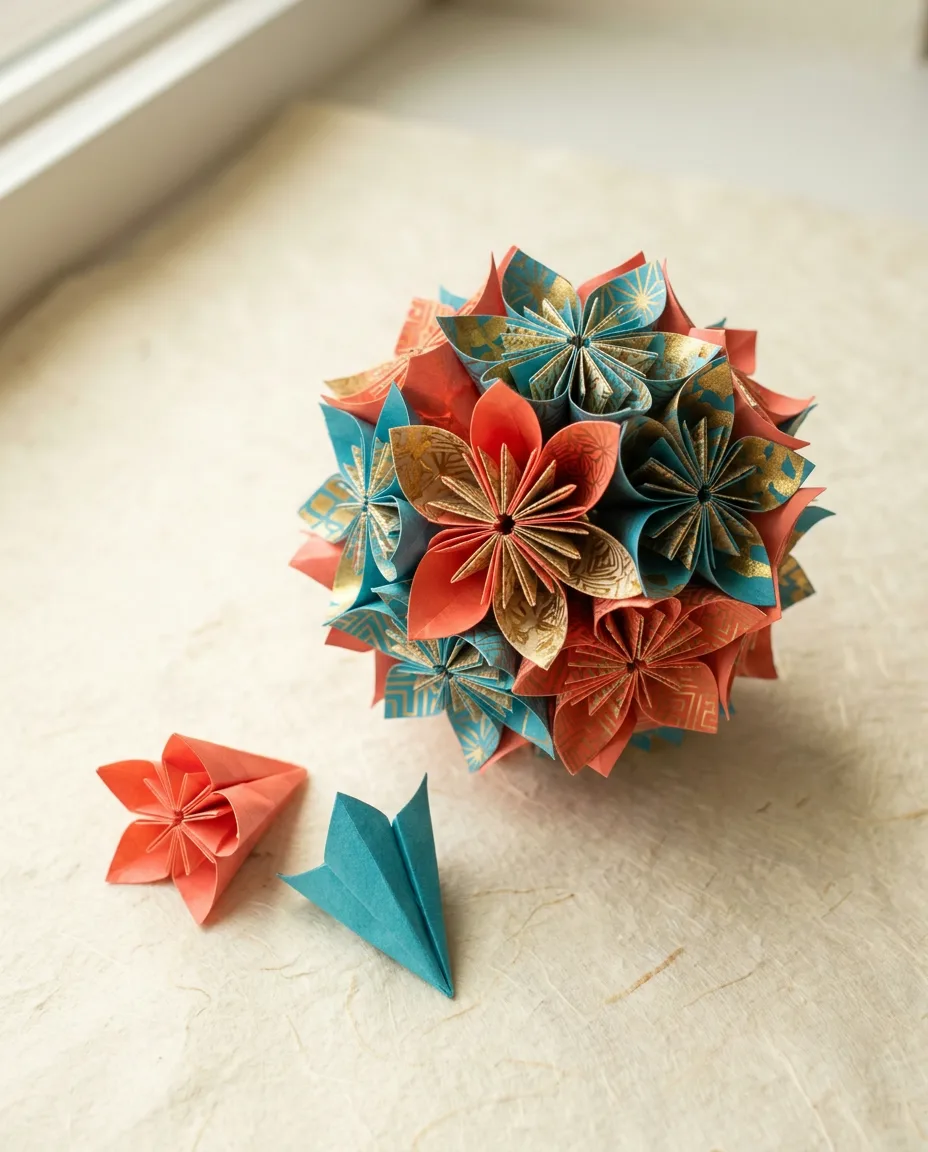
Each folded unit has flaps that end in points, and folds that open into pockets. Assembly is just tab-into-pocket, repeated. One connection is loose; three around a corner lock each other like hands gripping wrists, and the finished ball survives being dropped. The tension of the paper does all the work — which is why limp, soft paper makes wobbly modulars, and crisp kami makes solid ones.
The Sonobe unit: start here
The Sonobe is the Model T of modular origami — about eight folds, done in a minute once your hands know it. Six units make a cube. Twelve make a spiked ball; thirty make the classic icosahedral ornament. The unit is the same every time, so the skill compounds: learn it once, and the only question left is how many evenings you want to spend folding units in front of a show.
What a first project costs
- Six-unit cube — 6 squares, one sitting, zero frustration. Do this one first.
- Twelve-unit ball — one evening, and the point where assembly starts needing patience.
- Thirty-unit kusudama — two or three evenings of folding, one of assembly, and the one that earns the “you made that?”
Use three or four alternating colors; the assembly pattern distributes them beautifully with no planning. Keep units from 7.5 cm squares for ornament-sized balls, 15 cm for a centerpiece. Thin, crisp paper only — kami, not cardstock — because corners four layers thick still need to slide into pockets.
Kusudama and the older tradition
Kusudama — 薬玉, “medicine ball” — predates modern modular origami by centuries: folded or sewn flower balls hung with tassels, once filled with herbs and incense. Many classic kusudama flowers are glued, petal by petal, and purists argue about whether that still counts. Fold one and the argument stops mattering. Hang it over a desk; it reads as decoration in a way flat models never quite do, and it is the natural big sibling to the party folds.