Short answer
Start with cheap 15 cm kami, learn the valley and mountain fold, then fold models in this order: cat face, fortune teller, envelope, waterbomb, crane. Each one teaches the next.
Most people quit origami at the same spot: they pick the crane as their first model, reach the petal fold, and decide their hands are the problem. The hands are fine. The order was wrong. Here is a path that teaches the same skills with no wall in the middle of it.
Get paper that cooperates
Thick paper punishes beginners — it fights back on the third layer and holes open at corners. Standard 15 cm kami is cheap, thin, and colored on one side so diagrams make sense. A pack of a hundred squares costs less than a coffee. Printer paper cut square works for practice, but it creases stiffly and shows every mistake. (More in what paper to use.)
Learn two folds, not twenty
Every model you will fold this year is built from the valley and the mountain fold. Fold a square in half each way, corner to corner both ways, and flatten each crease with a fingernail until it sits sharp. That square of creases is not a model — it is a warm-up, and it teaches more than any video.
The first five models, in order
- The cat face. Eight creases, a face at the end. It teaches corners-to-a-point. Folded here, step by step.
- The fortune teller. Teaches the blintz fold and folding through layers. Diagrams here.
- The envelope. Teaches judgment folds — placing a crease by eye, not by landmark. Six folds, no glue.
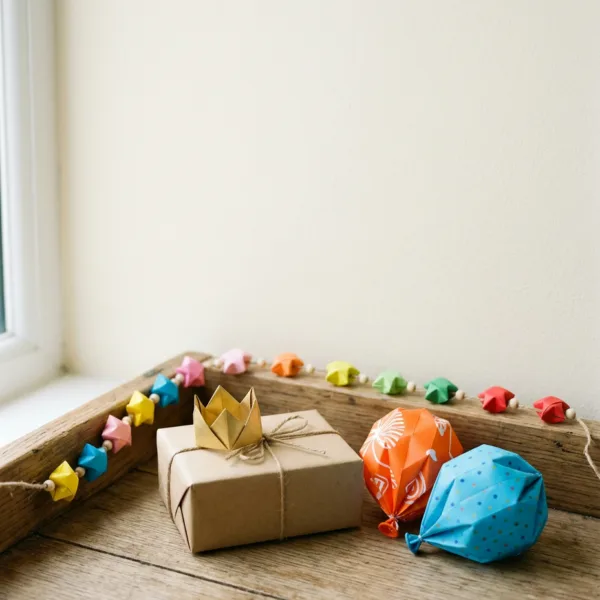
- The waterbomb. Your first 3D model, inflated with one puff. It teaches the preliminary base without telling you that is what it is doing.
- The crane. Now the petal fold has context, and the wall is a doorstep.
Habits that make everything easier
Fold on a hard table, never in the air. Line up edges before the crease, pinning them with one finger while the other hand flattens. Crease away from your body, once and hard. When a step confuses you, look one step ahead — a diagram’s next picture shows what you are trying to produce, and that is usually the explanation.
When something goes wrong
It will, and it is rarely fatal. Paper remembers creases, so a wrong fold leaves a ghost line — unfold calmly and the model usually survives. If a point refuses to lie flat, a crease underneath it missed its landmark by a hair; redo the one fold rather than crushing it flat. And when a sheet is truly beyond saving, it cost pennies. Take the fresh square, and the lesson.